The Evolution of Godzilla
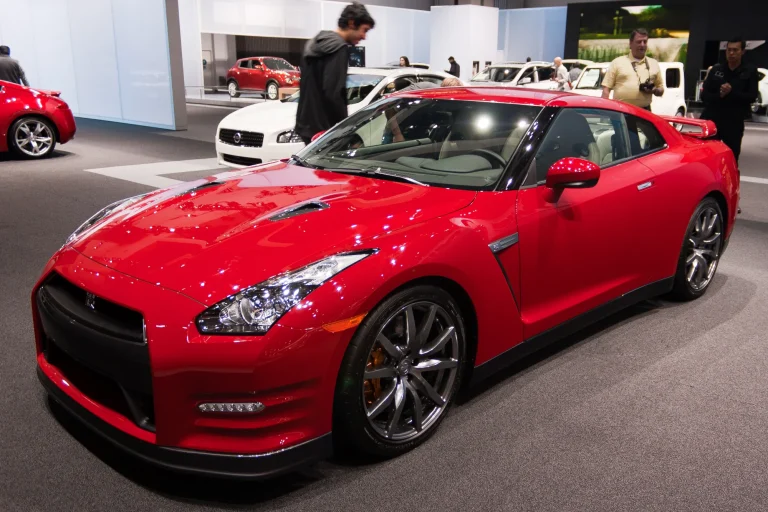
By 2012, Nissan’s R35 GT-R had already spent a few years dismantling the long-held beliefs of the exotic car establishment. Affectionately nicknamed “Godzilla” for its relentless appetite for swallowing up racetracks and higher-priced rivals alike, the GT-R was not born of subtle European lineage. Instead, it was forged as a digital-age technological tour de force. For the 2012 model year, Nissan introduced a significant update that pushed the envelope even further, squeezing more power out of the twin-turbocharged V6 and refining the chassis to handle the explosive output with surgical precision.
Development of the R35 platform broke away entirely from the Skyline lineage that came before it, adopting a dedicated mid-front engine layout with a rear-mounted transaxle for optimal weight distribution. The 2012 refresh wasn’t just about chasing higher dyno numbers; it was a comprehensive re-tuning aimed at sharpening reflexes, improving high-speed stability, and silencing critics who claimed the car relied too heavily on its computers rather than raw mechanical feedback.
Hand-Built Heart Every VR38DETT engine in the GT-R is painstakingly assembled by hand in a sterile, dust-free cleanroom by one of only a handful of master craftsmen known as Takumi.
It stood as a defiant middle finger to traditional supercars. While Italian and British exotics relied on atmospheric drama and exotic carbon construction, the GT-R used brute-force computer calculations, forced induction, and an ingenious all-wheel-drive system to conquer physics. It democratized extreme performance, offering acceleration that previously required a six-figure investment.
Engineering the Wind
Visually, the 2012 GT-R maintained its brutal, functional aesthetic. Every vent, crease, and duct served a specific thermodynamic or aerodynamic purpose. The front fascia received subtle modifications, including distinctive LED daytime running lights and revised lower air intakes that increased cooling airflow to the front brakes while reducing drag. At the rear, enlarged exhaust tips and a redesigned underfloor diffuser helped generate genuine downforce at triple-digit speeds.
- supercar
- coupe
- awd
- front-engine
- turbocharged
Beneath the muscular sheet metal lies a hybrid chassis structure combining high-strength steel, carbon fiber, and die-cast aluminum. This rigid skeleton is crucial for supporting the adaptive Bilstein DampTronic suspension system. Drivers could toggle through three distinct suspension modes—Comfort, R, and Normal—allowing the GT-R to transform from a firm highway cruiser to a flat-cornering track weapon at the push of a button.
Aerodynamic efficiency was a core pillar of the R35 project. The sleek roofline and wide stance were meticulously wind-tunnel tested to ensure high-speed stability across autobahns and circuit straights alike, proving that utility could coexist with aggressive styling.
The VR38DETT Powerplant
At the core of the 2012 GT-R is the legendary VR38DETT—a 3.8-liter, 24-valve, twin-turbocharged V6. For this model year, Nissan increased boost pressure, redesigned the intake and exhaust manifolds, and improved catalyst efficiency, driving output up to a formidable 530 horsepower and 448 lb-ft (607 Nm) of torque. This substantial power hike shaved critical fractions of a second off its acceleration times.
- Displacement: 3.8 liters with twin parallel IHI turbochargers.
- Horsepower: 530 hp delivered at 6,400 rpm.
- Torque Curve: A massive flat wave of torque available from 3,200 up to 5,800 rpm.
Power delivery is remarkably linear for a forced-induction engine. The twin turbochargers spool up almost imperceptibly, delivering a relentless wave of acceleration that pins occupants firmly to their seatbacks. The engine sings a mechanical, industrial symphony, accompanied by the distinct whistle of turbos and the crisp throttle blips of the gearbox.
Unprecedented Drivetrain Architecture
Routing over 500 horsepower to the pavement requires an exceptional transmission and driveline strategy. The GT-R utilizes a rear-mounted six-speed dual-clutch transaxle, a layout chosen to balance weight across the car’s axles. Uniquely, the GT-R employs a dual-propeller-shaft layout: one main carbon-composite shaft sends power from the engine to the rear transaxle, while a second independent shaft sends power forward from the transaxle to the front wheels.
“The GT-R doesn't just drive down the road; it calculates its grip and commands the pavement with ruthless computational efficiency.”
This ATTESA E-TS all-wheel-drive system operates like black magic. Under normal driving conditions, power is sent predominantly to the rear wheels. However, the system can dynamically shift up to 50 percent of torque to the front wheels the instant slippage is detected, ensuring traction in torrential downpours or blistering launches.
Track Capability and Braking
Bringing a 1,730-kilogram titan down from blistering speeds requires immense stopping power. The 2012 GT-R is equipped with massive Brembo monoblock six-piston front and four-piston rear calipers gripping cross-drilled, ventilated rotors. The braking system provides immense bite and remarkable resistance to fade, even under the grueling demands of repeated heavy track usage.
+ Pros
- Mind-bending acceleration and launch control
- Incomparable all-weather traction
- Supercar performance at a fraction of the price
– Cons
- Stiff, unforgiving ride quality
- Heavy curb weight
- Complex transmission can be clunky at low speeds
Grip is further maximized by bespoke Dunlop SP Sport Maxx GT 600 DSST CTT tires, specifically engineered for the GT-R’s unique weight distribution and suspension geometry. The resulting cornering grip defies expectations, allowing drivers to carry immense speed through sweeping bends with total confidence.
The Digital Cockpit
Inside, the 2012 GT-R balances a driver-focused cockpit with high-tech instrumentation. The standout feature is the multi-function display system, designed in collaboration with Polyphony Digital—the creators of the Gran Turismo video game franchise. It displays real-time telemetry data, including lateral G-forces, turbo boost pressure, oil temperature, and precise weight distribution graphs.
A Giant Killer
The 2012 Nissan GT-R R35 cemented its status as a modern legend. By blending supercar performance with everyday usability and technological mastery, it rewrote the rules of performance motoring.