
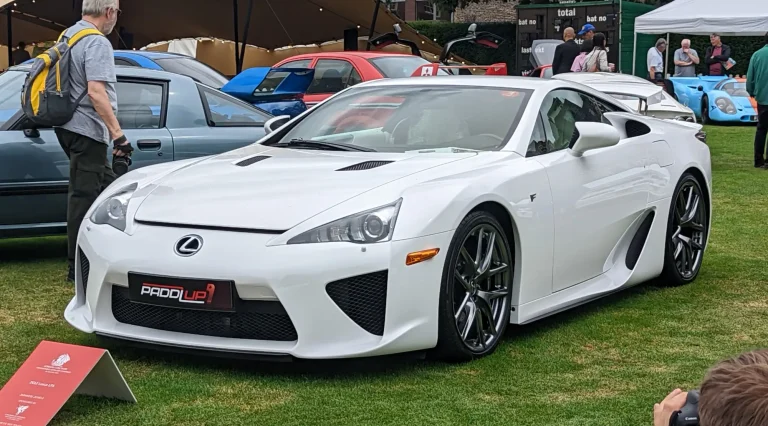
A decade-long detour from Lexus orthodoxy
Lexus built its reputation on quiet, cosseting luxury saloons, which makes the LFA’s origin story all the more unlikely. Development began in December 2002, when engineers started work on a bespoke V10 with no other Toyota or Lexus product in mind, an unusually open brief for a company that typically engineered from a defined market segment downward rather than starting with a blank sheet. Early testing mules were lapping the Nürburgring by 2004, and the project surfaced publicly as the LF-A concept at the 2005 Detroit auto show, years before Lexus committed to putting anything close to it into production.
What followed was almost a decade of quiet obsession. Lexus wanted a genuine flagship supercar to prove the brand could compete with Ferrari and Porsche on engineering terms, not just comfort. By the time the first production car rolled off a small, hand-built line in Motomachi in late 2010, the project had cost far more than any realistic sales volume could recoup, and Lexus never pretended otherwise, treating the LFA as a technology showcase rather than a profit center.
Reinventing carbon fiber to build it
Around five years into development, Lexus engineers made a decision that reshaped the entire project: switching the chassis from aluminum to carbon fiber reinforced polymer. No supplier could weave the complex 3D shapes they needed, and one specialist estimated it would take a decade to develop the process. Toyota’s engineers, drawing on the company’s roots as a maker of automatic looms, built their own circular carbon fiber loom instead, doing in about a year what others said was impossible. The finished machine used 144 bobbins to weave twelve layers of carbon fiber directly around a mold, a technique unlike anything used elsewhere in the industry at the time.
Fun Fact The LFA’s V10 revs from idle to its 9,000 rpm redline in around 0.6 seconds, so fast that a conventional analog tachometer needle couldn’t keep up, forcing Lexus to fit a digital display instead.
A V10 tuned like an instrument
The 4.8-liter naturally aspirated V10 was co-developed with Yamaha, a partner Toyota had leaned on for engine work for decades. Beyond raw output, Yamaha’s role extended to acoustics: engineers tuned the intake and exhaust to produce a sound the team openly compared to a Formula 1 car, routing it through the cabin via a dedicated sound generator rather than leaving it to chance. Every component from the intake trumpets to the exhaust tract length was treated as part of the instrument, not an afterthought bolted on once the engineering was finished.
- Power Output: 552 hp at 8,700 rpm
- Torque: 480 Nm at 6,800 rpm
- 0-60 mph: 3.6 seconds
- Top Speed: 202 mph (325 km/h)
Why a single-clutch gearbox, on purpose
Where most modern supercars had already moved to dual-clutch transmissions, the LFA used a six-speed automated sequential gearbox with a single clutch, mounted at the rear as a transaxle to help balance the car’s weight. Lexus argued the extra harshness on upshifts suited a car built around drama and mechanical honesty rather than lap-time-chasing smoothness, and the near 48:52 front-to-rear weight split backed up the engineering intent, with the engine set well back in the chassis to keep mass centered between the axles.
+ Pros
- Genuinely unique, hand-built engineering
- One of the great naturally aspirated engine notes
- Excellent weight distribution and chassis balance
– Cons
- Single-clutch gearbox feels dated next to rivals
- Extremely limited production and parts support
- Original price made it a hard sell against established rivals
Built in numbers too small to matter, commercially
Lexus capped production at 500 cars over roughly two years, a figure decided partly by cost and partly by the sheer time it took to hand-assemble each carbon-fiber tub. A 2012 model year update added the Nürburgring Package, with a stiffer chassis, more aggressive aerodynamics and a small power bump, limited to just 50 of the total run. Buyers of the standard car still received a genuine hand-built exotic, just without the extra track-focused hardware developed on the very circuit that shaped the car from its earliest prototypes.
“It doesn't feel like a Lexus at all, and that's the highest compliment I can give it.”
A halo car that never needed to make sense
Lexus lost money on every LFA built, and that was arguably the entire point. It exists as proof that the company could out-engineer supercar specialists when it wanted to, from a hand-woven carbon tub to a V10 tuned like a musical instrument. Rarity and a six-figure price kept it out of most driveways, but nothing else on sale in 2012 sounded, or was built, quite like it.