
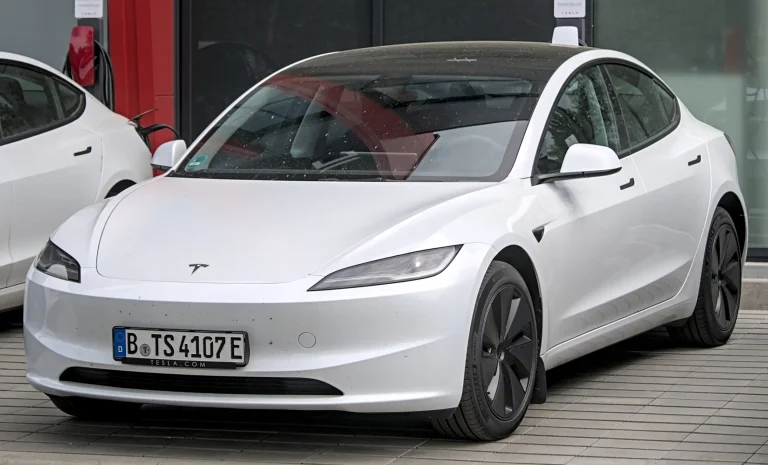
Refining the Everyday Electric Car
How the Highland Facelift Elevates the Base Model 3 Drivetrain
While multi-motor performance variants capture the major headlines, the true workhorse of the electric shift is the standard Rear-Wheel Drive Model 3. Refreshed under the internal ‘Highland’ moniker, this iteration focuses heavily on fixing the core critiques of past entry-level trims: cabin noise and ride harshness. By using continuous acoustic glass running throughout the greenhouse and redesigning the suspension bushings, the standard RWD model transforms from a stiff commuter into a quiet, highly isolated daily platform.
The exterior visual changes are deeply tied to aerodynamics. Sparing no wind-tunnel development, Tesla refined the front bumper profile and headlight assemblies to lower the drag coefficient to a striking 0.219. This aerodynamic slickness is critical for a single-motor layout, allowing the car to maintain high highway efficiency without needing a massive, heavy battery pack weighing down the chassis.
Efficiency-First Propulsion and the LFP Paradigm
Unlike its Long Range siblings that use Nickel Manganese Cobalt (NMC) chemistries, the standard RWD model heavily relies on a Lithium Iron Phosphate (LFP) battery pack. LFP chemistry brings distinct structural and ownership advantages:
- Full 100% Charging Capacity: Unlike traditional lithium batteries that prefer to stop charging at 80% to mitigate long-term degradation, LFP chemistry is highly durable and thrives when charged to 100% regularly, maximizing real-world daily utility.
- A Singular, Highly Integrated Inverter: A single permanent-magnet synchronous motor drives the rear wheels exclusively, producing 283 horsepower. Because it sidesteps the physical weight and drag penalties of an extra front induction unit, it extracts class-leading mileage metrics out of its 60 kWh usable energy footprint.
With 420 Nm of torque available immediately from zero motor RPM, the RWD model jumps off the line with the classic responsive character expected of a modern EV. It hits 0 to 100 km/h in a composed 6.1 seconds—firmly mimicking the behavior of modern hot-hatches without the internal combustion noise. Power delivery remains constant right up to its electronically limited top speed of 201 km/h.
An Accessible, Elevated Experience
Inside, the cabin shares the exact structural minimalism of the premium tiers. Driver metrics are relegated entirely to the 15.4-inch center panel, which now boasts brighter backlighting and faster response loops. The controversial omission of hardware steering column stalks means turn indicators are toggled via haptic icons directly on the steering wheel face.
Yet, the entry-level cabin feels far from cheap. Ambient LED strips loop smoothly across the fabric dash panels, ventilated front seats are included as standard equipment, and the rear bench gains a dedicated 8-inch screen for localized temperature changes and rear infotainment control.
The Fast Charging Threshold: Unlike the dual-motor variants that accept up to 250 kW, the LFP-equipped RWD model is electronically limited to a peak intake speed of 170 kW at DC fast chargers. However, because the LFP charging curve stays flatter for longer throughout the cycle, it can still recover roughly 165 miles of range in a swift 15-minute session under optimal conditions.
The Verdict: A Pragmatic Sweet Spot
The 2024 Tesla Model 3 Rear-Wheel Drive proves that an entry-level EV does not require driving compromises. By blending the mature structural improvements of the Highland platform with the bulletproof, low-maintenance daily traits of LFP battery cells, it remains the ultimate metric against which all mass-market electric sedans are judged.