
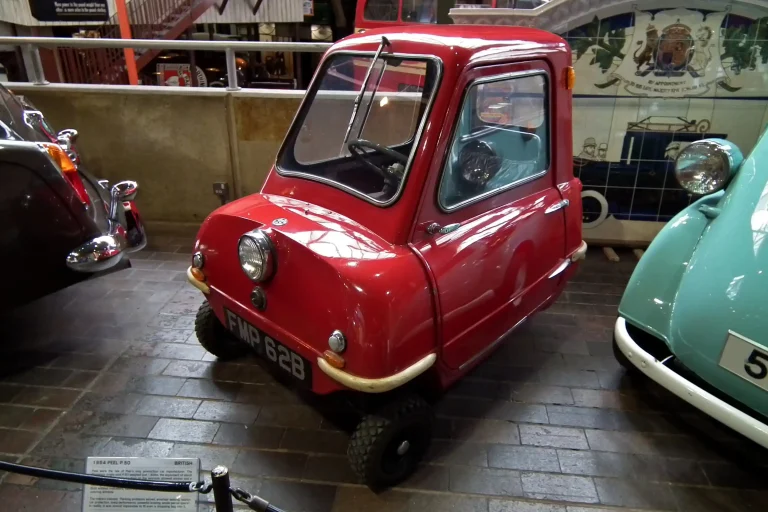
Why the Microscopic Peel P50 Became a Giant Automotive Icon
In a performance landscape dominated by thousand-horsepower hybrid weapons and colossal desert preying trucks, it is easy to forget that automotive design occasionally swings to the absolute opposite end of the spectrum. Back in the early nineteen-sixties, a boutique engineering firm on the Isle of Man asked a wonderfully absurd question: What is the absolute minimum amount of automobile required to transport a single human being?
The definitive answer was a vehicle so incredibly microscopic that it officially claimed the Guinness World Record for the smallest production car ever made. It was advertised to the public with a hilariously simple slogan: “Almost cheaper than walking.” It bypassed traditional automotive blueprints entirely, creating a cult icon that continues to capture hearts globally through its sheer, unfiltered charm.
Less Than a Moped on Three Wheels
To put its size into perspective, this tiny cruiser is comfortably shorter than a standard office desk and narrow enough to fit straight through a standard pedestrian doorway. The underlying engineering philosophy didn’t just trim the fat—it aggressively amputated every single component deemed non-essential to locomotion.
The minimalist architecture relied on a few key elements:
- The entire structural shell was molded out of ultra-lightweight fiberglass, completely omitting an underlying steel chassis frame to eliminate dead weight.
- The mechanical packaging utilized three tiny wheels, completely bypassing heavy, complex four-wheel independent suspension setups.
- The vehicle was equipped with a single door on the left side, a solitary windshield wiper, and one lonely central headlight dominating the front nose.
Powering this featherweight pod was a tiny, moped-derived single-cylinder two-stroke engine. Drivers managed the propulsion through a three-speed manual transmission, sending power directly to the single rear wheel.
The Reverse Gear Is You
The most famous quirk of the powertrain engineering wasn’t what it included, but what it left out: the gearbox had absolutely no reverse gear.
If you drove into a tight parking corner or encountered a dead end, backing out required a distinctly physical ritual. The rear end of the fiberglass body was fitted with a simple, heavy-duty chrome grab handle. The driver had to physically step out of the cabin, lift the rear wheel off the ground using the handle, and manually wheel the entire car around like a piece of rolling luggage.
Inside the sparse cabin, luxury was non-existent. The driver sat directly on a minimalist canvas or vinyl seat hammock slung right over the floorboards, with their legs wrapped tightly around the steering column. There was no instrument cluster to track—just a simple ignition switch, a clutch pedal, and the raw, noisy vibration of the two-stroke engine buzzing inches away from your spine.
The Verdict: A Million-Dollar Micromachine
With only a highly limited double-digit number of original units ever manufactured during its initial sixties production run, genuine survivors are exceptionally rare prizes in the modern collector market. They regularly command staggering six-figure sums at elite global auctions, frequently selling for higher premiums than brand-new Italian supercars.
It stands as a brilliant, joyous monument to functional packaging. It proved that an automobile doesn’t need to shatter sound barriers or climb mountain ranges to secure permanent immortality—it just needs to bring a massive, unstoppable smile to absolutely everyone who sees it trundling down the road.