
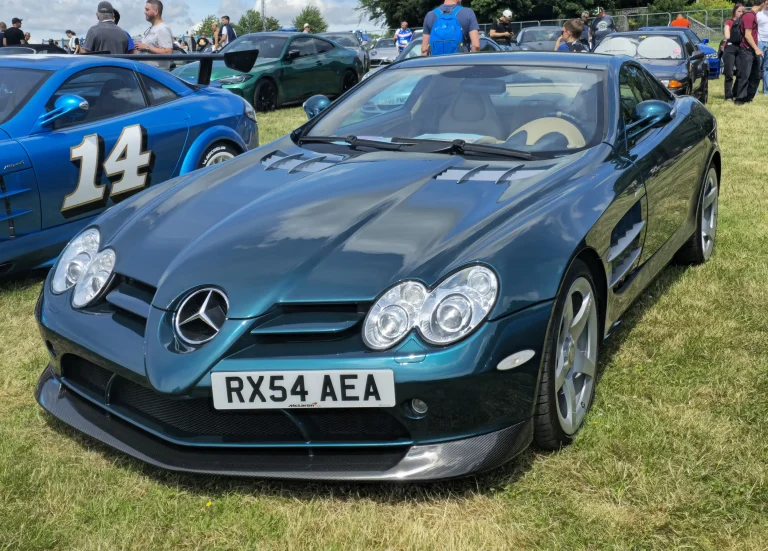
The Clash of Titans That Created a Legend
How Mercedes and McLaren Forged a Thunderous, Carbon-Fiber Concorde for the Road
In the early two-thousands, Mercedes-Benz and McLaren were an unstoppable force on the Formula 1 grid, harvesting world championships with Mika Häkkinen at the wheel. Seeking to capitalize on this silver-tinted golden era, the two automotive powerhouses decided to collaborate on the ultimate road-going grand tourer. The result was the Mercedes-Benz SLR McLaren—a vehicle named in honor of the iconic 1955 300 SLR racing car.
However, behind the scenes, the car’s development was a conceptual war zone. Mercedes wanted an ultra-luxurious, everyday-usable, front-engined Autobahn cruiser equipped with premium creature comforts. McLaren—led by the legendary design purist Gordon Murray—wanted a lightweight, uncompromised, mid-engined hypercar. The final production car became a fascinating, thunderous compromise: a carbon-fiber, front-mid-engined land missile with a presence that remains completely unmatched.
The Formula 1 Nose and Side-Pipe Magic
Walking up to the SLR McLaren, your eyes are instantly drawn to its wildly dramatic proportions. The arrow-shaped, twin-nostril front nose directly mimics the front wing of contemporary McLaren Formula 1 cars. Because Gordon Murray fiercely insisted on a completely flat underbody and an integrated rear diffuser to suck the car to the tarmac at high speeds, traditional rear exhaust pipes were out of the question.
This layout forced a brilliant, hot-rod style engineering solution:
- The roaring exhaust gases are routed to exit through short side-pipes cutting directly out of the front fenders, right behind the front wheels.
- When the car is driven hard, this setup blasts a ferocious, unfiltered mechanical heavy-metal symphony directly outside the driver’s window.
To ensure the heavy bodywork didn’t dull its reflexes, the entire outer shell and internal structure were crafted from high-tech Carbon Fiber Reinforced Plastic (CFRP)—making it one of the very first mainstream production cars to utilize a full carbon-fiber monocoque chassis.
The Heart of an Earthquake: The AMG Kompressor V8
Instead of using a high-revving, naturally aspirated racing engine, Mercedes won the powertrain argument by dropping a mechanical hammer under the long hood: a hand-built 5.4-liter supercharged V8 engine (codenamed the M155).
To satisfy Gordon Murray’s strict weight-distribution requirements, the massive engine block was pushed entirely behind the front axle line, making it a true front-mid-engined layout.

- The Power Output: The twin-screw Lysholm supercharger shoves 13 psi of boost into the aluminum V8, churning out a staggering 617 horsepower and 575 lb-ft of torque.
- The Gearbox Choice: Rather than utilizing an early, unrefined dual-clutch or automated manual gearbox that would struggle with the engine’s brutal torque curve, Mercedes elected to use a bulletproof 5-speed torque-converter automatic. It shifted smoothly around town but would lock up instantly in manual mode to handle high-speed sprints up to an eye-watering top speed of 207 mph.
Active Airbrakes and Unforgiving Carbon Ceramics
At triple-digit speeds, slowing down a 3,800-pound grand tourer safely requires monumental stopping power. The SLR was fitted with high-performance carbon-ceramic brake discs clamped by massive multi-piston calipers.
The hydraulic brakes are heavily augmented by an active aerodynamic element: the deployable rear airbrake.
When you stomp on the left pedal at high speeds, the rear lip spoiler instantly pops up to a steep 65-degree angle. This movement increases high-speed rear downforce to keep the chassis stable under hard braking, while acting as a giant aerodynamic sail to help bleed off speed in a fraction of the time.
Scaling the SLR Family Tree
Over its production lifecycle at McLaren’s pristine facility in Woking, England, the SLR platform evolved into increasingly exclusive, high-value collector variants:
| Variant | Body Style | Special Enhancements | Rarity |
| Standard Coupe / Roadster | Closed Top / Soft Top | The original, luxurious long-distance cruiser format | ~2,157 units |
| 722 Edition | Upgraded Coupe | Named after Stirling Moss’s 1955 Mille Miglia start time; upgraded to 641 hp, stiffer suspension, and 19-inch wheels | 300 units |
| Stirling Moss | Speedster | A radical, windshield-less, roofless tribute car that shed 440 lbs; top speed increased to 217 mph | 75 units |
The Infamous “SLR Brake” Learning Curve: The car features an early Sensotronic Brake Control (SBC) brake-by-wire system. Because the pedal controls digital sensors rather than a traditional hydraulic link, the low-speed brake response is notorious for being incredibly grabby. Crawling smoothly through a parking lot or tight traffic requires a highly delicate touch to prevent your passenger from repeatedly nodding forward.
The Verdict: A Modern Hyper-GT Masterpiece
While it didn’t hit its optimistic initial target of building 3,500 units, the SLR McLaren has aged like fine wine. It defied traditional automotive categorization: it was too luxurious and heavy to be a pure track car, yet far too loud, exotic, and violent to be a lazy grand tourer.
Today, clean examples command immense respect and surging market values. It remains a legendary monument to a brief time when two engineering superpowers compromised their core beliefs to create a thunderous, butterfly-doored hyper-GT.