
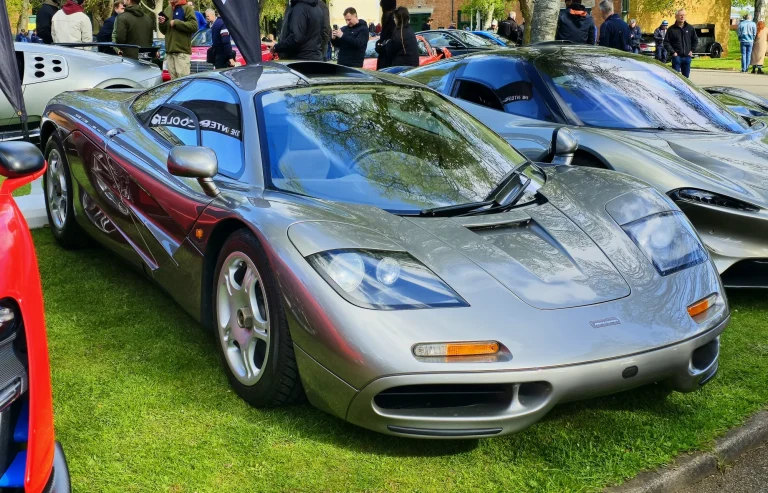
The idea behind the F1
The McLaren F1 began with an unusually ambitious question: what would the ultimate road car look like if its designers were given almost complete freedom? The idea emerged in 1988 during discussions between senior McLaren figures returning from the Italian Grand Prix. Gordon Murray became the project’s technical leader, working alongside Ron Dennis and designer Peter Stevens to create a car focused on lightness, driver involvement and engineering efficiency rather than simply chasing headline power.
Four years of development produced a road car unlike anything McLaren had built before. The F1 was unveiled in 1992 and became the company’s first production road car. Its carbon-fibre monocoque, central driving position, three-seat cabin, naturally aspirated V12 and six-speed manual transmission gave it a character that was fundamentally different from contemporary supercars.
Central driving position The driver sits in the middle of the cabin, with a passenger seat on each side. McLaren chose the layout to give the driver an unusually clear view and make the driving experience the centre of the car.
A BMW V12 at the heart of it
McLaren required an engine that combined enormous performance with compact dimensions, low weight and exceptional reliability. BMW Motorsport supplied the answer in the form of the S70/2, a 6.1-litre naturally aspirated V12 developed specifically for the F1. It produced 627 hp at 7,500 rpm and approximately 650 Nm of torque, with the power delivered through a traditional six-speed manual gearbox.
- Power Output: 627 hp
- Torque: 650 Nm
- Engine: 6.1L Naturally-Aspirated V12
- Maximum Engine Speed: 7500 rpm
- Transmission: 6-speed manual
- Drivetrain: RWD
- Kerb Weight: approximately 1140 kg
- 0-100 km/h: approximately 3.2 seconds
- Top Speed: approximately 386 km/h
- sportscar
- coupe
- mid-engine
- rwd
- naturally-aspirated
- manual
- limited-edition
The engine was installed behind the cabin and became one of the F1’s defining engineering achievements. McLaren even used gold foil in the engine compartment as a heat-reflective material because of the V12’s considerable heat output. Almost every component was scrutinised for unnecessary mass, helping the finished car remain remarkably light by supercar standards.
Lightness was the real weapon
Rather than depending on turbochargers or four-wheel drive, McLaren pursued performance through weight reduction. The F1 used a carbon-fibre monocoque, lightweight aluminium and magnesium components and an exceptionally compact cabin. The result was a kerb weight of roughly 1,140 kg, giving the car an exceptional power-to-weight ratio for its time.
The suspension used double wishbones, while the braking system relied on conventional steel discs rather than the carbon-carbon technology associated with later hypercars. Aerodynamic efficiency was also carefully considered. The F1’s underbody generated useful aerodynamic performance without requiring the enormous wings seen on dedicated racing machines, while a computer-controlled rear airbrake could deploy under heavy braking.
Performance that became legendary
The F1’s acceleration was extraordinary for a naturally aspirated manual road car. It could reach 100 km/h in roughly 3.2 seconds and continued building speed with remarkable urgency. The most famous figure came from prototype XP5, which reached 386.4 km/h, or 240.1 mph, making the F1 the fastest production road car in the world at the time and establishing a record that remains associated with the car decades later.
What makes the performance particularly remarkable is how it was achieved. There was no turbocharging, hybrid motor or automated dual-clutch transmission. The driver controlled the car through a manual gearbox while the high-revving BMW V12 delivered its power directly to the rear wheels. Its performance came from the combination of engine response, low mass, aerodynamic efficiency and gearing.
“The McLaren F1 remains the fastest naturally aspirated road car ever built.”
From road car to Le Mans winner
The F1 was not limited to road-car performance. McLaren developed the F1 GTR for competition, transforming the road-going concept into a successful endurance racer. Its greatest achievement came at the 1995 24 Hours of Le Mans, where an F1 GTR won the race outright against purpose-built prototypes. The result demonstrated that the fundamental engineering philosophy of the road car could translate successfully to one of motorsport’s toughest events.
The competition programme also influenced the development of later F1 variants. The F1 LM paid tribute to the Le Mans victory with a more focused specification, while the F1 GT was developed as a road-going homologation special for the long-tail racing programme. These cars are even rarer than the standard F1 and contribute to the model’s extraordinary historical significance.
Only 106 examples
McLaren produced only 106 examples across the complete F1 programme, including road cars, prototypes and racing derivatives. The standard road car itself was extremely limited, and the small production run was part of the car’s original character rather than an artificial scarcity strategy. Every example received extraordinary attention to detail, from its bespoke interior to its hand-finished components.
The F1’s rarity has made it one of the most valuable modern collector cars. Individual examples have sold for many millions of dollars, with provenance, specification and history having a major effect on value. Its collectability, however, is only part of its importance. The F1 remains influential because its engineering philosophy was so uncompromising.
Why the F1 still matters
Modern hypercars can accelerate faster, generate more downforce and use vastly more sophisticated electronic systems, but the F1 occupies a different category of achievement. It was designed around a simple objective: create the best possible driver’s car using the technology and engineering knowledge available at the time. Carbon-fibre construction, a central driving position, naturally aspirated V12 power and low mass all served that goal.
That purity explains why the F1 remains one of the most respected cars in automotive history. It was fast enough to set world records, successful enough to win Le Mans and rare enough to become an icon. More than three decades after its debut, the combination of mechanical simplicity and engineering ambition still gives the F1 a character that is difficult for newer cars to reproduce.
+ Pros
- Exceptional power-to-weight ratio
- Iconic naturally aspirated V12
- Central driving position
- Six-speed manual gearbox
- Historic Le Mans-winning pedigree
– Cons
- Extremely rare and expensive
- Limited practicality
- Very demanding maintenance
- Modern hypercars are quicker in several measures
The McLaren F1 is ultimately remembered not because it had the biggest engine or the most technology, but because every component served a coherent idea. It remains a benchmark for lightweight engineering and driver-focused performance.
A benchmark that still feels special
The McLaren F1 remains one of the purest supercars ever produced. Its lightweight carbon-fibre construction, screaming BMW V12, manual transmission and central driving position created a combination that modern technology has made faster, but arguably not more distinctive.