
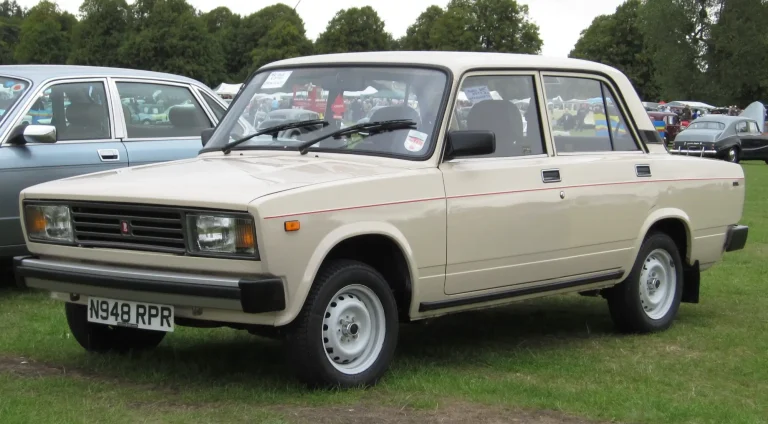
A Fiat in a fur hat
Every Riva, whatever badge or engine sat under the bonnet, traced its family tree back to the Fiat 124, a car AvtoVAZ licensed from Turin in the late 1960s to build the first modern Soviet family saloon. That original VAZ-2101 became a runaway domestic success, selling millions of units across the Eastern Bloc, and by the mid-1970s the factory at Tolyatti was already planning a facelifted, more contemporary-looking replacement with squarer styling, a revised dashboard and improved corrosion protection.
Prototypes of that car were running by 1977, and production began in the Soviet Union in 1980 as the VAZ-2105 and VAZ-2107, initially for the domestic market where demand for private cars still comfortably outstripped what the factory could build. Western Europe had to wait until 1983 to see it, badged as the Lada Riva, and the mid-range 1500 quickly became the volume seller: more usable than the wheezy 1200 and 1300, but far cheaper than the range-topping SLX. It struck a balance that many British buyers, weighing up a used Ford against a new Lada, found hard to argue with.
Simple, sturdy, and easy to fix
Mechanically, the Riva 1500 changed very little from the car it replaced, since Soviet planners saw no reason to re-engineer a design that was already cheap to build and easy to service in even the most remote corners of the country. Coil springs sat at all four corners, the rear axle was a live unit located by trailing arms and a Panhard rod, and drum brakes did duty at the back. It was old-fashioned engineering even in 1988, but it meant a Riva could be kept running with basic tools and cheap parts almost anywhere in the world, and independent garages rarely struggled to find a way to fix one.
- Power Output: 80 hp at 5,600 rpm
- Torque: 106 Nm at 5,600 rpm
- 0-60 mph: 14.5 seconds
- Top Speed: 95 mph (153 km/h)
The engine that did the heavy lifting
The 1500’s 1.5-litre carburettor-fed four-cylinder was the sensible middle ground in the Riva line-up, borrowed from the earlier VAZ-2103 and tuned for low-down pulling power rather than outright speed. It drove the rear wheels through a five-speed manual gearbox, giving it a genuine edge in refinement over the base four-speed 1200 and 1300 models it sat above, and making it noticeably more relaxed at motorway speeds on longer journeys.
+ Pros
- Simple mechanicals, cheap to maintain
- Generous interior space for the money
- Five-speed gearbox smoothed out motorway driving
– Cons
- Slow, even by 1988 standards
- Basic ride and handling
- Modest build quality
A familiar sight on British roads
In the UK, the Riva’s reputation was built almost entirely on value. Autocar magazine, reviewing the range, praised its low list price and a surprisingly long list of standard equipment for the money, including height-adjustable headlamps, a heated rear window and a 21-piece toolkit in the boot. None of it disguised the car’s age, but none of it needed to, since buyers were rarely cross-shopping it against anything genuinely modern in the first place.
By 1988, more than 30,000 Ladas were finding UK buyers a year, the vast majority of them Rivas like this one, making Lada a genuinely mainstream presence on British roads rather than the curiosity it is often remembered as today. Steel wheels, plain bumpers and unassuming colours such as this car’s cream paintwork were the norm rather than the exception; flashy trim, extra brightwork and the fancier grille were reserved for the SLX further up the range, leaving the 1500 to trade almost entirely on substance over style.
“You bought a Riva with your head, not your heart, and that was exactly the point.”
Where it stands now
Most Rivas were used hard and scrapped without ceremony, which makes clean survivors like this one a genuinely rare sight today. What they lack in speed and polish, they make up for with a straightforwardness that has all but vanished from modern motoring, and that is precisely why a small but devoted following keeps them on the road, swapping parts and know-how through owners’ clubs long after Lada quit the UK market in 1997.
Unglamorous, and unapologetic about it
The Lada Riva 1500 was never going to win a beauty contest or a road test shoot-out, and it didn’t try to. It offered a family-sized saloon, a five-speed gearbox and genuine reliability for a fraction of what rivals charged, and that honest bargain was more than enough to keep it selling steadily right through the 1980s.